Writing
Don’t Add AI. Redesign the Company.
Why copilots, licenses and AI pilots won’t make your company AI-Native.
24 September 2026 · 4 min read
AI First. Relentlessly Human.
Every company has an AI strategy now.
They are buying licenses. Launching copilots. Running pilots. Building chatbots. Creating AI councils. Training employees on prompting.
And yet, walk through how most of those companies actually operate and very little has changed.
The same meetings happen. The same approvals happen. The same spreadsheets get created. The same information gets copied between systems. The same employees spend hours searching for information. The same workflows move from person to person to person.
AI has been added. The company hasn’t been redesigned.
That is the problem.
The biggest opportunity in enterprise AI is not making the existing company 20% more efficient. It is asking a much bigger question: If we started this company today, with AI agents, abundant intelligence and automation available from day one, would we design it this way?
For most enterprises, the answer is no. That is where becoming AI-Native begins.
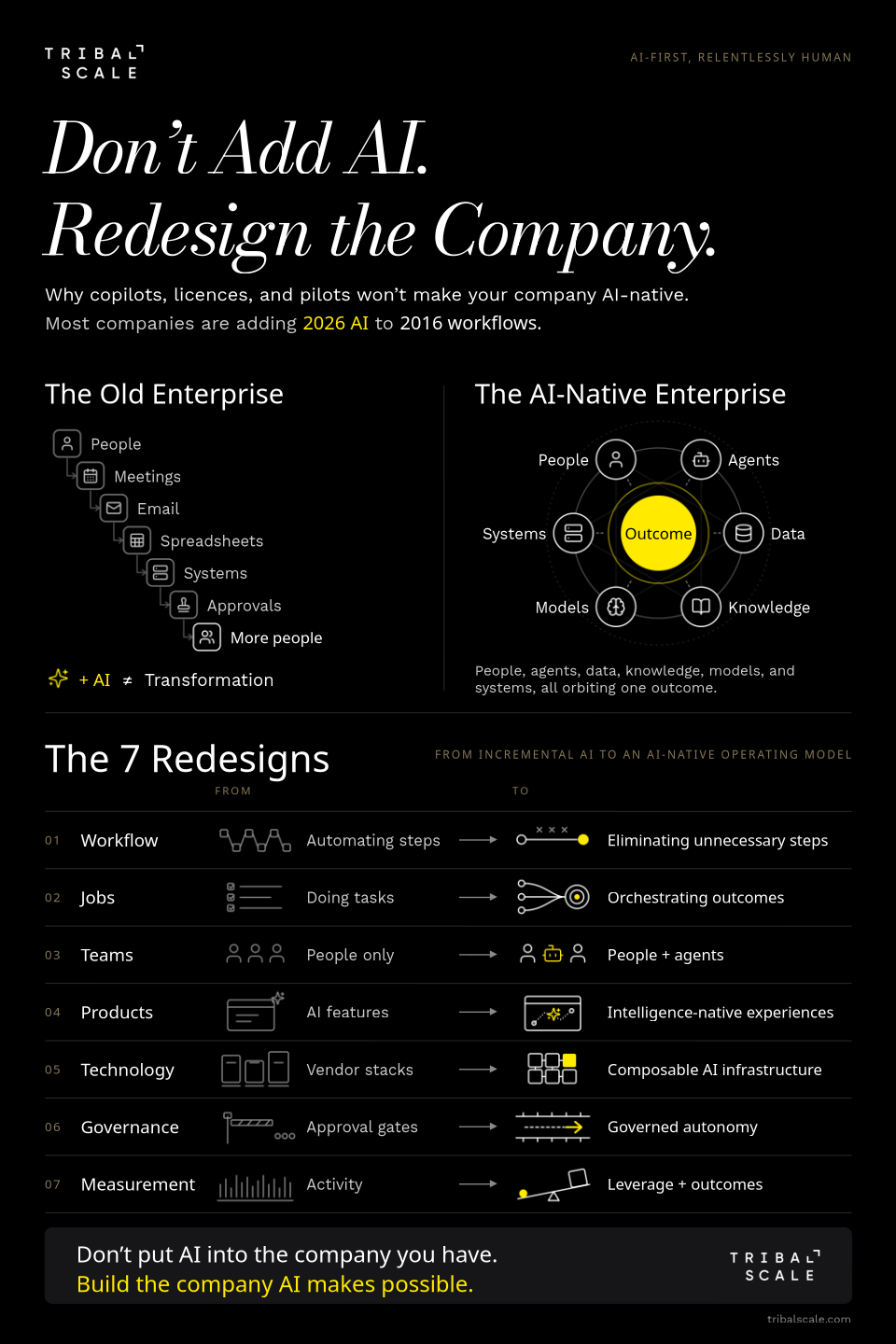
Most companies are adding 2026 AI to 2016 workflows
1. Redesign the Workflow
The most common enterprise AI pattern is to take an existing workflow and insert AI into one step. A person still starts the process. The same systems still exist. The same approvals still happen. AI simply makes one part faster. That can create value, but it is not transformation.
An AI-Native organization starts from the outcome and works backward. Which steps exist because humans historically had limited time, limited information or limited ability to coordinate? Which handoffs can disappear? Which decisions can be made automatically within clear guardrails? Which work can agents complete before a person ever touches it?
Don’t automate yesterday’s workflow. Redesign the workflow around what is possible now.
2. Redesign the Job
For decades, jobs have been bundles of tasks. Research this. Prepare that. Update the system. Build the deck. Write the report. Send the follow-up.
AI changes the economics of those tasks. The question is no longer just, ‘How can AI help this employee work faster?’ It becomes, ‘What should this person own when agents can perform much of the execution?’
The highest-leverage employees will increasingly define outcomes, provide context, make judgment calls, orchestrate agents and improve the systems around them. The job moves from doing every task to owning the result.
3. Redesign the Team
The org chart is about to become incomplete. A modern team is no longer just the people listed under a manager. It can include specialized agents for research, analysis, coding, QA, customer support, knowledge retrieval and operations.
That does not make people less important. It makes human judgment, creativity, empathy, leadership and accountability more important. The strongest teams will learn how to combine those human strengths with machine speed and scale.
The future team is people + agents + workflows + models + institutional knowledge.
4. Redesign the Product
Adding a chatbot to an existing product is not the same as building an AI-Native product. Intelligence should change the experience itself.
What happens when the product understands the customer’s context? When it anticipates intent? When it can complete an outcome instead of simply presenting another screen? When the interface can adapt to the user rather than forcing the user through a fixed workflow?
The opportunity is not another AI feature. It is an intelligence-native experience.
5. Redesign the Technology Stack
The model landscape changes too quickly to hard-wire the enterprise around one model or one vendor. Different workloads will require different trade-offs across reasoning, coding, voice, vision, latency, privacy and cost.
AI-Native architecture needs flexibility: model abstraction, routing, enterprise context, governed access to tools and data, reusable agent infrastructure, observability and evaluation.
The goal is not to predict which model wins. The goal is to build an enterprise that can continuously use the best intelligence available for each workload.
6. Redesign Governance
Traditional governance was designed for systems that behaved predictably and changed relatively slowly. Agentic systems can reason, call tools and take actions. Governance therefore has to move into the architecture.
Identity. Permissions. Data access. Auditability. Observability. Evals. Human approval. Escalation. Security. These cannot be bolted on after the pilot works.
The goal is not unrestricted autonomy or endless approval gates. It is governed autonomy: giving AI systems enough authority to create value while making their actions visible, bounded and accountable.
7. Redesign How You Measure Work
AI will make many traditional productivity measures increasingly misleading. Hours worked. Tickets closed. Documents produced. Lines of code. Tasks completed.
If one employee creates a system that performs a process thousands of times, individual activity tells you very little about that person’s impact.
AI-Native companies should increasingly measure outcomes, leverage, reusable systems, quality, speed, customer impact and organizational capacity. The question shifts from ‘How much did you do?’ to ‘What did you build that can keep creating value?’
AI-Native Is a Redesign, Not an Upgrade
This is why the AI transformation conversation needs to get bigger. AI is not simply another software rollout. It changes what work can be done, who or what can do it, how quickly decisions can happen and how organizations can scale intelligence.
The companies that win the AI era will not necessarily be the companies that buy the most AI. They will be the companies willing to challenge how they operate and redesign themselves around what AI makes possible.
That is the difference between AI-enabled and AI-Native.
Don’t put AI into the company you have.
Build the company AI makes possible.
AI First. Relentlessly Human.